Curriculum
At Marymount Barranquilla we are a learning community in which the formative experience seeks to develop 21st century skills, global competence and positive entrepreneurial leadership based on solid human values.
For this we implement a pedagogical model supported by national and international standards; we practice teaching for understanding, meaningful learning and the development of the dimensions of being and knowledge, taking into account the stages of evolution of the learner.
Each area of knowledge finds its reference in a set of national and international standards that indicate the academic content to be addressed during the school year; all subjects follow the guidelines of the Ministry of National Education and designated international guidelines.
Standard Curriculum
In the case of English, Science and Mathematics, starting in 2019 Marymount School adopted the Cambridge curriculum; in English Social Sciences the AERO Standards are used, French is developed through the Common European Framework, Physical Education has NASPE (National Association for Sport and Physical Education in the USA) as a reference, Art uses NAFME (National Association for Music Education in the USA), Library is supported by AASL (American Association for School Libraries), Technology develops ISTE (International Society for Technology in Education) and Religion organizes its content according to the Episcopal Conference.

Elective Classes
Exploration Elective Classes and Academic Spaces for Research, Design, Creation and Innovation. These learning-experience spaces within the academic schedule are designed from Kindergarten to 12th grade, taking into account the voice of the students giving them the opportunity to choose where to invest their time and the type of project to be carried out. They are based on models such as STEAM, MAKER movement, Regio Emilia, among others.
Curriculum by levels
11th and 12th grade emphasis options
From the Academic Direction we would like to share with our community the different emphases that are offered in 11th and 12th grade so that our students can enhance the academic profile they require for their future university careers. Some important aspects are: Emphasis options: (1) Advanced Math and Engineering, (2) Advanced Biology and Science, (3) Advanced Economics, Humanities and Arts.
The emphasis chosen in 11th grade continues through 12th grade. Below is a table detailing the subjects taught in each of these emphases.
Curriculum by subjects and levels
Language: English and Spanish
Preschool
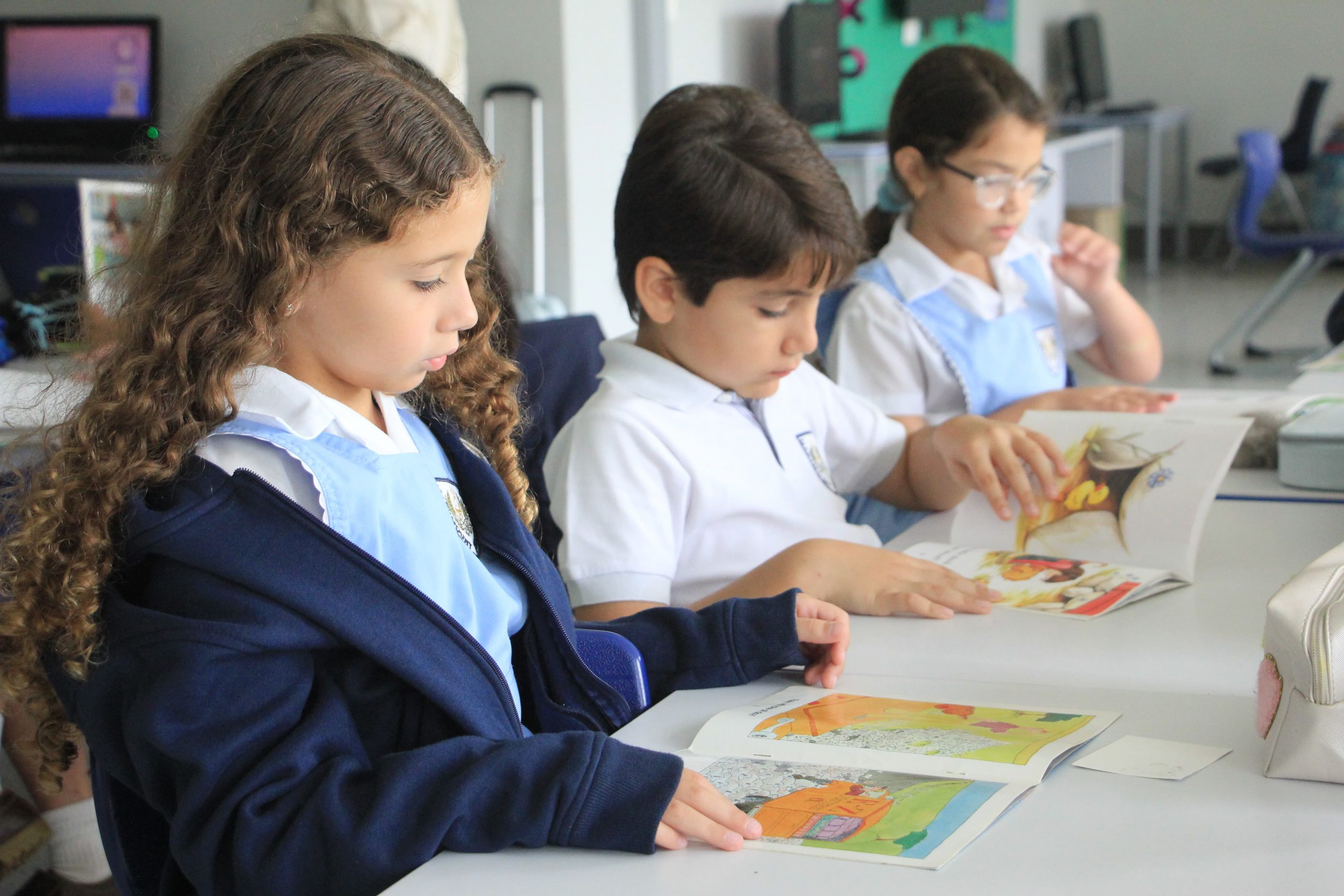
In Nursery, students begin their immersion in English through rhymes, songs, stories and games that allow them to develop their alphabetic knowledge, phonological awareness, vocabulary, comprehension and oral production. In Pre-Kindergarten, through playful activities, she strengthens her body scheme, coordination, visual and auditory perception, as well as her fine motor skills as a basis for her calligraphy process. Similarly, it develops their phonemic awareness as a basis for good decoding and fluency in their reading process, as well as to enhance encoding as part of their writing process. They will begin their reading comprehension in both languages from a primary analysis of the literal message of the text, and more deeply using stories from the library in the classroom. At the Kindergarten level, they develop literacy skills with various types of text in both languages, while strengthening their spelling and handwriting.
Elementary
Students strengthen their reading from decoding, fluency and comprehension in both Spanish and English. Likewise, they apply strategies to develop a primary level of inference, identify the parts of the story, the main idea of a text, recognize some literary figures and the structure of a poem. They also learn to analyze explicit and implicit language, as well as to determine different textual typologies. In addition, they develop their textual production from the approach of a writer, elaborating different types of texts where they express themselves with a vocabulary according to the level, coherence and sufficient details. Through presentations, projects and class activities, they demonstrate their oral competence with intonation and fluency.
Bachillerato
Through the reading plan and other library resources in the classroom, students strengthen critical thinking and the ability to infer implicit messages in various types of texts (literary and non-literary) based on content analysis, reading comprehension strategies, formal characteristics and communicative intentions. Additionally, they strengthen their communicative competence to express a point of view with coherence and cohesion, good command of grammatical and orthographic aspects, as well as a high register vocabulary. Similarly, they develop their global competence through the presentation of projects that are framed in authentic scenarios, demonstrating ownership and mastery of the subject. In addition to their preparation process for the Saber 11 tests, students participate in the Explore Horizons project to acquire knowledge and research skills that will help them determine their professional projection.
Mathematics and Geometry
Preschool
Using play as a learning tool and based on the CPA teaching principle, which uses physical and visual aids to develop the child's understanding of abstract topics, mathematics in the early years focuses on the development of mathematical vocabulary and the sections of Numbers, Geometry and Measurement, finally incorporating Statistics. In the section on numbers, their recognition, counting principles, estimation and understanding of operations are explored in order to relate to their environment. In Geometry and Measurement, they create a spatial awareness, recognizing figures, positions and sizes in their real life, and finally in Statistics, they represent information and answer questions that provide answers to real investigations.
Elementary
Relying on the use of manipulatives, skills and concepts are developed in relation to Numbers, Geometry and Measurement, Statistics and Probability, allowing them to recognize the interconnections between various mathematical concepts.
At these levels, the Numbers section, which is the foundation of mathematical understanding, leads to explore counting principles, develop numerical fluency and acquire computational skills applicable in other sections and real life situations. The Geometry and Measurement section focuses on improving spatial awareness and applying numerical skills in various contexts, exploring size, shape and position of geometric shapes, as well as measurement of attributes, providing them with tools to visualize and solve real-life problems and finally, the Statistics and Probability section emphasizes the interpretation of statistics, an essential skill that allows students to understand the data they encounter in their daily lives.
High School
Incorporating the use of technological tools such as calculators and software, high school mathematics has new sections in its curriculum. The Numbers section explores the complexities of the number system, develops fundamental computational skills, and addresses increasingly complex calculations. The Algebra section extends from pre-algebra concepts in the primary stages to the use of algebraic and graphing techniques, improving reasoning skills and the ability to identify and generalize patterns and rules. In Geometry and Measurement, students acquire the ability to visualize and solve real-life problems, using mathematical tools and digital technology to create accurate geometric representations. Statistics and Probability places a strong emphasis on the statistical inquiry cycle, to understand data they encounter in their daily lives, even in unfamiliar presentations. It also empowers them to recognize misleading representations of data, as often happens in media or advertising.
In grades 9th - 10th, the IGCSE curriculum continues to expand concepts in the sections of numbers, algebra, geometry and measurement, statistics and probability and incorporates the section of functions, where they are analyzed and connected with real situations from the graphic, algebraic, numerical aspects and their properties and also the trigonometry section that seeks to analyze and solve situations involving triangles, from the knowledge of their sides and angles.And finally in 11th - 12th, through the AS & A curriculum, concepts are expanded in the sections of algebra, functions, geometry and trigonometry, statistics and probability and the sections of calculus are added, where functions, their changes and how those changes are and the section of differential equations where the equations of any function with its derivatives are analyzed. This structured approach to mathematics provides students not only with mathematical competence, but also with critical thinking skills to understand the world from a mathematical perspective.
Science: Physics, Chemistry and Biology
Preschool
In the Preschool levels, children's natural curiosity is encouraged as they explore the world around them. They will begin implementing the scientific method to learn about: the characteristics of living things, the parts of their bodies, the forces that act on objects, the materials they are made of, and how they relate to the environment. They will develop skills to think, act and express themselves as scientists. We encourage children's active exploration as they carefully observe the world around them and ask questions about what they see. Through playful activities, children learn to organize information and communicate what they have observed, thus developing scientific skills from an early age.
Elementary
In the elementary grades, we foster the development of science skills through a variety of approaches. Students learn to use models and representations to understand scientific objects, systems, and processes, enabling them to explain abstract ideas and make predictions based on their observations. In addition, the importance of scientific inquiry is emphasized. Students learn to plan and conduct experiments, collect evidence, analyze data, and reach informed conclusions. Practical work plays a crucial role. Students acquire skills in observation, measurement and equipment handling, enabling them to collect accurate and reliable data for their investigations. These skills lay the foundation for students to relate their scientific knowledge to observable and verifiable phenomena, preparing them to make better decisions about the world around them.
Knowledge of the natural sciences is developed as follows: Biology focuses on the study of living things and their interactions. Students gain an understanding of life processes, including how the structure and development of living things enable them to maintain those processes. Chemistry addresses the study of matter, which comes in the form of materials composed of substances. Students develop an understanding of materials and substances, their properties, and the physical and chemical changes they undergo. Physics focuses on the study of the interaction between matter and energy. Students gain knowledge about how heat and electric current are transferred through matter, how light and sound behave, how magnets interact, and how forces affect objects. Earth and Space covers the study of the planet Earth, the Solar System and beyond. Students develop understanding of the connections between the land, oceans, atmosphere, and life on our planet. They will investigate how the key cycles that shape our planet are closely linked to the Solar System. They will also explore Earth formation, geology and climate.
Baccalaureate
At the high school level, the use of scientific skills is reinforced through a variety of approaches. Among the purposes are to enable students to acquire scientific knowledge and understand scientific theories and practices. It is also intended to develop a variety of experimental skills, including manipulation of variables and following biosafety standards. Students will learn to use scientific data and evidence to solve problems and discuss the limitations of the scientific method. In addition, students are expected to be able to communicate effectively and clearly, using scientific terminology and conventions. It is important that they understand that the application of scientific knowledge can benefit society and the environment. Finally, it is intended that students enjoy science and develop an informed interest in scientific issues that support further study. These objectives are achieved through a variety of educational activities that encourage active student participation and promote a deep and lasting understanding of scientific concepts.
Global Studies
Preschool
In preschool, Global Studies lays the foundation for a lifelong appreciation of global perspectives by nurturing curiosity, empathy, and respect for diversity. Through play-based learning, storytelling, and hands-on activities, young learners explore fundamental concepts such as identity, community, and the natural world. They develop essential skills like communication, collaboration, and critical thinking in an inclusive and supportive environment. The curriculum introduces simple yet meaningful topics such as family traditions, cultural celebrations, and environmental stewardship, instilling values of kindness, tolerance, and environmental responsibility. By engaging in imaginative play, creative arts, and sensory experiences, preschoolers begin to understand their place in a global community and embrace the richness of human experience. Through the Global Studies Department, young learners embark on a journey of discovery, laying the groundwork for a future characterized by empathy, curiosity, and a deep appreciation for global diversity.
Elemental
Cambridge Global Perspectives in elementary education fosters a dynamic learning environment that encourages students to develop essential skills while exploring a range of engaging topics. Through collaborative activities, critical thinking exercises, and inquiry-based projects, students cultivate skills such as research, communication, and problem-solving. They delve into topics that span cultural diversity, environmental sustainability, global citizenship, and technological advancements, gaining a deeper understanding of the interconnected world around them. Activities include group discussions, hands-on experiments, virtual field trips, and multimedia presentations, all aimed at nurturing students' curiosity and broadening their perspectives. Elementary students not only acquire knowledge but also develop the skills necessary to become informed, empathetic, and proactive global citizens.
Baccalaureate
In high school, Global Studies offers an enriching educational experience that equips students with advanced skills and a nuanced understanding of global issues. Through rigorous inquiry-based learning, students engage in critical analysis, independent research, and collaborative projects, honoring skills such as problem-solving, communication, and intercultural competence. The curriculum delves into complex topics such as both World Wars, the Cold War, geopolitical trends, sustainable development, human rights, and technological innovation, encouraging students to examine global challenges from multiple perspectives. High school students participate in a variety of activities including debates, simulations, research papers, and community service projects, all designed to deepen their understanding of global interconnectedness and foster a sense of global citizenship. By immersing themselves in the subject, high school students emerge as informed, empathetic, and socially responsible individuals prepared to navigate the complexities of our ever-changing world.
Social Sciences
Elementary
Students will describe their physical, social, cultural and emotional characteristics that make them unique and different. They will know their country, population, traditions, symbols and emblems to generate national identity. They will know the basic rules of the Manual of Coexistence, participating in the construction of new agreements that respond to the needs of their classroom, school and community. Identify different types of landscapes of our national territory; the climate, the regions and the economy that develops taking into account the characteristics of the regions. Explain the cultural diversity of the country since the organization of the first communities, analyzing the dynamics of transformation of political-administrative institutions as a consequence of geographical discoveries. Analyze the advantages and disadvantages of the geographical and astronomical position of the country for its economy and how historical processes influenced the living conditions of the population of Neogranada. They will learn about children's rights and identify local, national and international institutions that watch over their fulfillment.
Baccalaureate
Students will describe the characteristics of the Earth (movements, geographic coordinates and time zones) and the physical geography of the continents. They will be able to understand characteristics of American and Colombian societies in order to analyze processes and techniques of conflict mediation. Recognize causes, processes and consequences that involve social problems initiated since the European expansion in the 15th century. They will develop research and presentation skills throughout the year related to the Sustainable Development Goals. Students will recognize the ongoing relationship between humans and the main characteristics, functions and services provided by ecosystems. Students will explain changes in political processes in Colombia and the world throughout the twentieth century to the present, with emphasis on conflicts, political processes and tensions arising from state power.
God's Faith Club
Preschool
In God's Faith Club Preschool, children embark on a beautiful adventure to discover God's love in every corner of the world around them. Through games, songs and creative activities, they learn about God's love in the family, where dad, mom and their siblings are a gift from God.They also explore nature, that wonderful creation of God, full of flowers, animals and colors that speak to us of His infinite goodness and care. With joy, they discover God's love in the Virgin Mary, a heavenly mother who always protects and guides them. In God 's Faith Club, faith becomes a compass that helps them make the right decisions and become better people. They learn that God's love is also found in friends, those playmates who share smiles and hugs. And finally, the church becomes a second home, where they gather to celebrate the joy of being loved by God through their prayers and teachings.
Elemental
Students will learn about: God, the creator of the universe, their responsibility with the care of the "Common House" and the life of their brothers and sisters. Also the life that Jesus communicates to us and how to grow in the Church, about the experiences of friendship with God and with people. Also about friendship in the life of Jesus and how service and fraternity are a source of unity in the Church. They will learn about celebration in people's lives around their family, society and religiosity, and celebration in the life of Jesus, in the life of the Church and the feasts of the liturgical calendar. Vocation as the realization of the person and the vocation of Jesus, as a proposal of life for the human being, and how the Christian vocation is lived within the Church. Finally, they will learn about authentic witness in the life of the Catholic in today's society, how to strengthen a model of human being inspired by the beatitudes, and how in the Church every Christian must work for the common good.
Baccalaureate
Students will have the Human Being as the central axis of their Religious Education: They will reflect on the meaning that Jesus Christ gives to the person, elevating his dignity and placing him at the service of the Church. They will learn about the family as the primary cell of society and the Church, they will critically analyze the mission of the Christian family and the challenges of today's world, and also about the Gospel of marriage, the family and its contribution to a society that moves towards peace and reconciliation. They will be able to distinguish the communitarian dimension of the human being, the message of Jesus through his community of disciples, the value of the contributions of the ecclesial community as a servant of unity and development of peoples towards justice, equality and the common good. They will be able to identify and analyze ethical criteria and the foundations of Christian morality, relating them to the dilemmas and problems of today's world. They will critically compare the teachings of Christian morality with what is happening in international agreements, the environment, human rights, education, among others, and will make proposals aimed at their resolution. They will propose life projects that embrace the Church's vocation of service, the practice of mercy and the positive contribution to the transformation of society. Finally, they will learn about the construction of a new society: the contributions of the Church based on the Gospel for the construction of a new society based on respect, responsibility, solidarity, honesty and the common good. They will propose personal changes that contribute to a better community life and will take initiatives that promote positive changes in favor of justice, fraternity and the common good.
Physical Education
Preschool
Students will have developed sensory-motor skills and abilities through playful activities, reinforcing concepts such as jumping, climbing, pulling, pushing, lifting and carrying, in an environment of constant reinforcement for values, acceptance and discovery of their own body. In addition, differentiation strategies will be implemented to adapt the activities according to the individual needs of each student, thus ensuring optimal and meaningful learning for all.
Elemental
Students will have developed and applied a variety of biomotor skills through games and directed activities where concepts such as balance, strength, coordination and speed are transferred, in an environment of constant reinforcement by values. Additionally, they will have initiated the practice of pre-sports activities through playful games such as touch ball, kickball, throwing and catching, etc., under an environment of constant reinforcement by values. To ensure the success of all students, differentiation strategies will be implemented to adapt activities according to individual needs, thus promoting inclusive and meaningful learning.
Baccalaureate
Students will have strengthened their physical, coordination and sports skills through strength, speed, endurance and sports games, among others; under an environment of constant reinforcement of values and sports ethics, developing healthy lifestyle habits. To ensure optimal and equitable learning, differentiation strategies will be implemented to adapt to the individual needs of each student, thus encouraging active and meaningful participation in physical and sports activities.
Plastic arts
Preschool
Art & Design, while in preschool, allows students to explore their creativity and express themselves through a variety of art forms. They will experiment with artistic media, consider the artistic process that all artists follow, and use focus and perseverance to turn their creative ideas and experiments into personal and collaborative works of art. Throughout their artistic journey, students will also benefit from reflecting on their own experiences and those of others.
Elementary - Middle School
Art & Design, during their time in elementary, allows students to explore their creativity and express themselves through a variety of art forms. They will experiment with artistic media, seek out their own artistic experiences, consider the artistic process that all artists follow, and use these to express their creative ideas and experiments through both personal and collaborative artwork. Throughout their artistic journey, students will also learn the benefits of reflecting on their own experiences, the work of other artists, the experiences of other learners, and the various contexts from which art has evolved.
Baccalaureate
Art & Design, as it moves through high school, is designed to offer a wide variety of media and approaches so that students can produce a personal response and build on their strengths in terms of experience and interests. Areas of study include painting and related media, graphic communication, three-dimensional design, textiles and fashion, and photography. Students should be able to record their own experiences and observations both firsthand and from secondary sources and through personal research. They must have the ability to collect, record, and respond to visual information using a variety of techniques, as well as to select, contextualize, and organize information in a coherent manner. In addition, it is crucial that they can effectively employ a wide variety of resources and use the information obtained to develop their artistic practice. This involves conducting personal research, applying a variety of skills to produce art and design work, and being able to evaluate their own work, review, edit and reflect on it to refine and adapt their creative approach.
Music
Preschool
In Music, students will develop the ability to identify the importance of sound and recognize the diverse sounds that are generated in their environment, whether through nature, their own body or music. In addition, they will acquire skills to control pulse, musical accent and other rhythmic elements. They will also explore timbre, phrasing and changes of dynamics in rhythmic-melodic compositions. They will be introduced to the different families of musical instruments, such as strings, winds and percussion, through activities involving at least one instrument from each family.
Elemental
In the Music course, students experience diverse sonorities through the use of different musical instruments, such as boomwhackers, minor percussion, xylophones, piano and ukulele. They will enrich their musical vocabulary through the interpretation of musical scores and will be able to respond according to their expanded lexicon in musical notation, covering aspects such as musical figures and notes, rhythmic and melodic reading, as well as major and minor scales and chords. They will begin their foray into musical composition with the creation of simple melodies, incorporating body movement to facilitate the internalization of different musical concepts and music technology programs for this purpose. They will explore melodic contour and cultivate an appreciation for musical contrasts, textures and dynamics. They will learn to play in ensembles, blend with other musicians, coordinate their playing with other instrumental or vocal lines, and collaborate effectively in ensembles.
Baccalaureate
In the Music course, students delve into the composition of melodic, rhythmic and rhythmic-melodic pieces, entering the most creative phase of musical composition. They will learn to use digital composition platforms that will facilitate the learning process and will have the opportunity to perform their own works, developing musical pieces that can be shared with an audience, always enjoying the musical process.
Technology
Preschool
At the end of the school year, students are introduced to basic technology concepts as part of their initial learning and skill development process. This is done following the standards established by ISTE (International Society for Technology in Education) and in accordance with the digital literacy pathway designed for preschool grades.
Elementary and High School
The Technology program is based on the standards outlined by the ISTE. At Marymount College, this program is structured around three academic pillars that focus on the skills and competencies essential to thrive in an interconnected digital world. This program prioritizes the development of skills according to the age and level of the students, gradually scaling the standard as follows:
- Preschool through 2nd grade: Digital Citizenship, Digital Literacy
- Grades 3-6: Digital Citizenship, Digital Literacy and Introduction to Computer Science.
- Grades 7-12: Computer Science, Digital Literacy and Digital Citizenship.
Philosophy
Baccalaureate
Students in Grades 11 and 12 will study philosophical knowledge, investigate and analyze the history of philosophy through philosophical competencies such as thinking for oneself, being oneself, thinking with others. They will reflect and argue from ancient to contemporary philosophy, emphasizing the processes of the human being that make him/her a true philosopher. They will study epistemological, anthropological, ethical, aesthetic and logical areas of philosophy, while developing philosophical practice based on three main competencies: deepening, problematizing and conceptualizing. They will develop research and presentation skills throughout the year.
Economics and Politics
Baccalaureate
Students in Grades 11 and 12 will study changes in economic processes in Colombia and the world today with emphasis on Microeconomics, Macroeconomics and Globalization. They will recognize and analyze causes, processes and consequences involving political and economic issues of the present time. Develop research and presentation skills throughout the year.
French
Baccalaureate
The French program of Marymount School aims to train bilingual citizens in French language and French-speaking cultures corresponding to level B1 of the Common European Framework of Reference for Languages, in coherence with the provisions of the bilingualism plan and the curricular guidelines for foreign languages of the Ministry of National Education.
The methodology for the achievement of the objectives proposed by the Alianza Colombo Francesa for the students of Marymount School responds to the guidelines of the European Framework and corresponds essentially to the approach of learning by doing. In this approach, the student is the center of the learning-teaching-evaluation process and will be able to accomplish tasks associated with the language level of learning in multiple environments (public, personal, professional and educational) that will be faced in their social life as an active subject of action (social actor).
Our students develop the general competence of the language level defined for their learning (A1, A2 or B1) as well as the specific competences corresponding to listening, reading, writing, speaking in monologue and interaction. This pedagogical process, combined with a high presence of the cultural component, facilitates the acquisition of the French language, and the appropriation and interaction of the cultural specificities of French-speaking countries.
Electives
7th-8th Grade
Semillero Matemático
Astronomía
Drama
First Aid
Math Tricks
Radio Marymount
Physical Activity and Health
Viajemos por Colombia
Travelling 101
Art
Communication Skills
French
9th-10th Grade
Semillero de Matemáticas
MBSN Journalism
First Aid
Marymount Learner
Film Studies
Travelling 101
SAT Prep Course
Praying and Singing
Construyamos Energía, Soliarizate
Palabras en red
Rediscover Jesus
11th-12th Grade
Music Angel Show (Art)
Physics Applied to Design
Theatre/Acting (Art)
SAT Preparation
Chess
Mix Media (Art)
Travelling 101
College Applications
Application Resume and Essay Writing
Graphic Design
Speaking and Presentation Skills
Singing and Praying